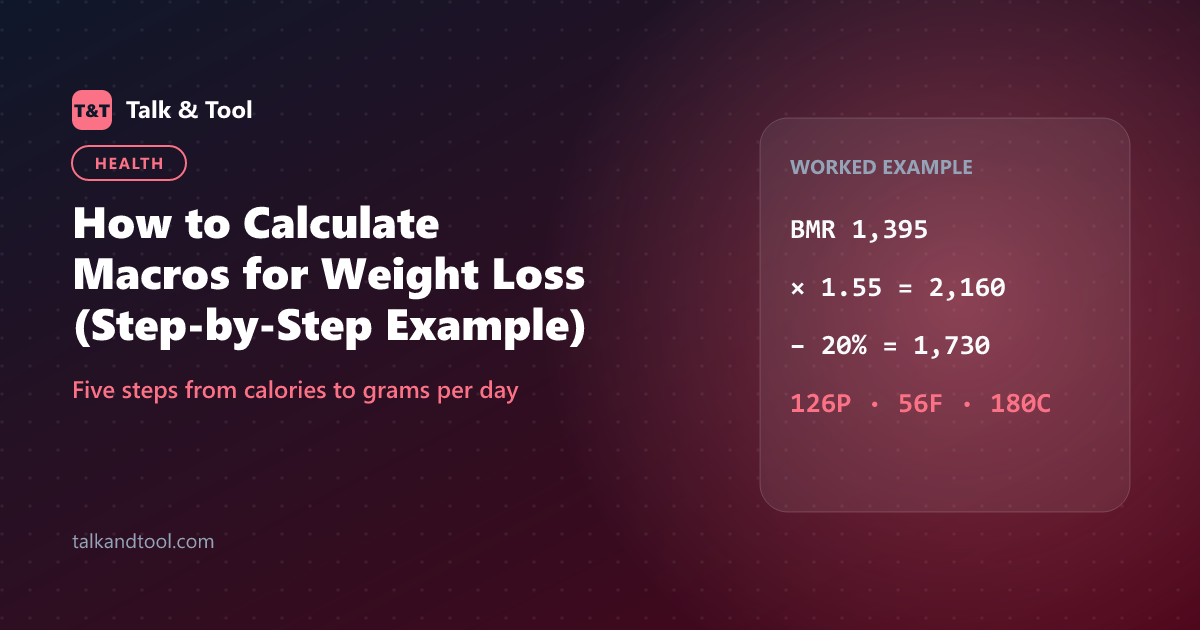
How to Calculate Macros for Weight Loss (Step-by-Step Example)
To calculate macros for weight loss, estimate your daily calorie burn, subtract a moderate deficit, set protein and fat in grams per kilogram of body weight, and give the remaining calories to carbohydrates. Below is the full method with a worked example, so you can check any macro calculator's numbers by hand.
This is general information, not medical advice. If you are pregnant, have a medical condition, or have a history of disordered eating, talk to a doctor or registered dietitian before changing your diet.
The numbers you need
Every macro plan rests on four facts:
- Protein has 4 kcal per gram.
- Carbohydrate has 4 kcal per gram.
- Fat has 9 kcal per gram.
- Alcohol has 7 kcal per gram and counts toward calories but not toward any macro.
Step 1: Estimate your BMR
Basal metabolic rate is the energy you burn at complete rest. The Mifflin-St Jeor equation is the most widely used estimate:
- Men: 10 × weight (kg) + 6.25 × height (cm) − 5 × age + 5
- Women: 10 × weight (kg) + 6.25 × height (cm) − 5 × age − 161
For our example, a 35-year-old woman who is 70 kg and 165 cm: 700 + 1,031 − 175 − 161 = 1,395 kcal.
Step 2: Multiply by activity to get TDEE
Total daily energy expenditure adds everything you do on top of resting. The standard multipliers:
- 1.2: sedentary (desk job, little exercise)
- 1.375: lightly active (exercise 1–3 days a week)
- 1.55: moderately active (exercise 3–5 days a week)
- 1.725: very active (hard exercise 6–7 days a week)
- 1.9: extremely active (physical job plus training)
Most people overestimate their activity. If unsure, pick the lower level. Our example: 1,395 × 1.55 = about 2,160 kcal to maintain weight.
Step 3: Subtract a deficit
A deficit of 15–25% below TDEE is a common, sustainable range. It usually produces a loss of about 0.5–1% of body weight per week. Larger deficits speed things up at first but make hunger, muscle loss and rebound more likely.
Example: 2,160 × 0.80 = about 1,730 kcal per day.
Step 4: Set protein first
Protein is the most important macro when dieting: it helps preserve muscle and is the most filling per calorie. A common evidence-based target during weight loss is 1.6–2.2 g per kg of body weight, especially with resistance training. If you have a lot of weight to lose, base it on your goal weight instead.
Example: 1.8 × 70 = 126 g protein = 504 kcal.
Step 5: Set fat, then carbs
Fat supports hormone production and absorption of fat-soluble vitamins. Around 0.6–1.0 g per kg, or 20–35% of calories, is a sensible range. Example: 0.8 × 70 = 56 g fat = 504 kcal.
Carbohydrates get whatever calories remain: 1,730 − 504 − 504 = 722 kcal ÷ 4 = about 180 g carbs.
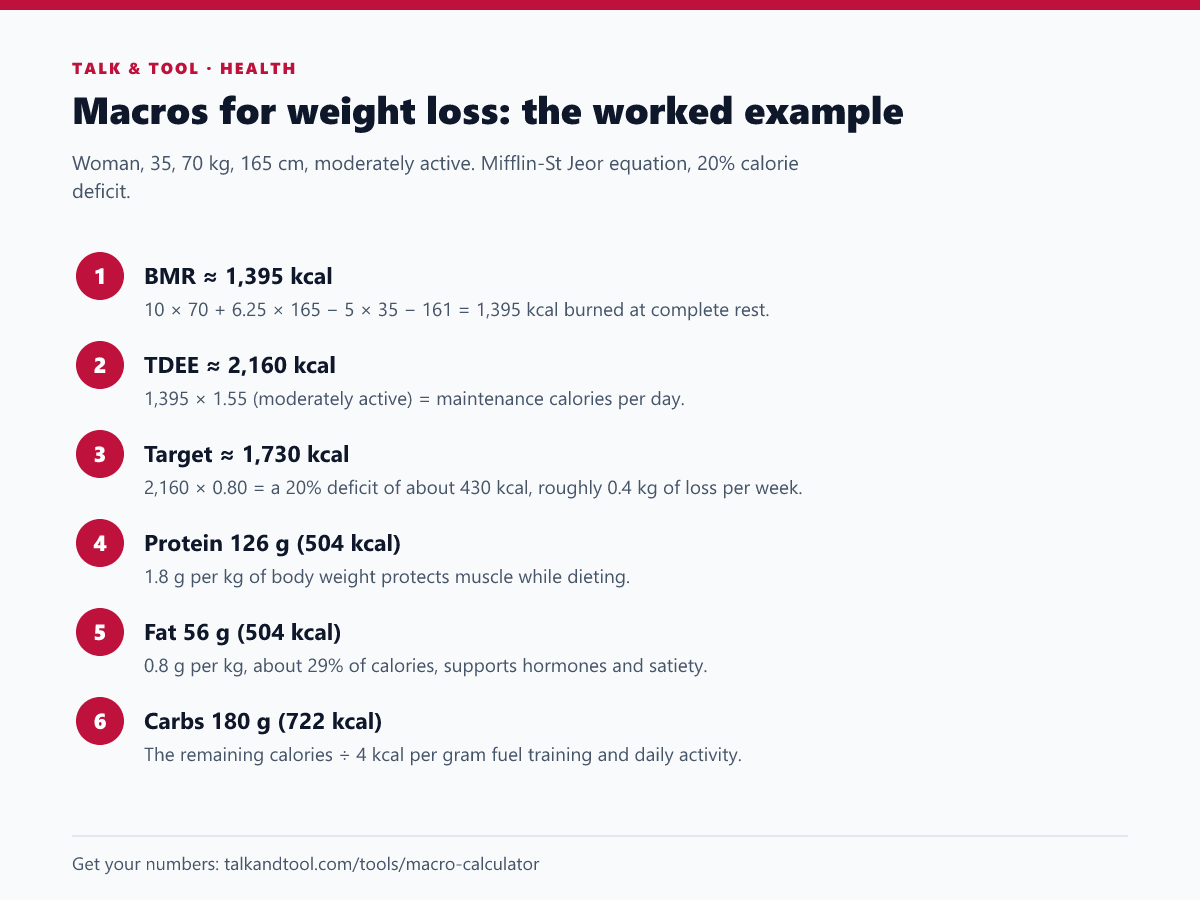
Final plan: 1,730 kcal, 126 g protein, 56 g fat, 180 g carbs. That works out to roughly 29% protein, 29% fat and 42% carbs. The macro calculator splits your calories into protein, carb and fat grams, with a weight-loss preset. It also shows your protein per kilogram, so you can check it against the 1.6–2.2 g range.
Percentage splits vs grams per kilogram
Many macro calculators use a fixed split like 40/30/30. That is simple, but it scales protein with calories rather than body size. A heavier, very active person on 3,000 kcal would get 225 g of protein at 30%, and a small person on 1,400 kcal only 105 g. Setting protein and fat per kilogram and letting carbs flex is more accurate for both. Use percentages as a sanity check, not the starting point.
Adjusting after two to three weeks
Every equation is an estimate. Individual metabolism varies by a few hundred calories either way. Weigh yourself under the same conditions several times a week and compare weekly averages:
- Losing 0.5–1% a week: keep going.
- No change after 2–3 weeks: reduce calories by 100–200, preferably from carbs or fat, not protein.
- Losing faster than about 1% a week and feeling drained: add 100–200 kcal back.
Recalculate every 4–5 kg of weight lost, because a lighter body burns less.
Common mistakes
- Counting exercise calories twice, once in the activity multiplier and again by "eating back" tracker estimates.
- Setting calories too low. Very low intakes are hard to sustain and make adequate protein and nutrients difficult. A registered dietitian can set a floor that suits you.
- Ignoring cooking oils, sauces and drinks, which can easily add several hundred untracked calories a day.
- Chasing perfect numbers. Landing within about 10 g of protein and 100 kcal of the target most days is enough.
If you want a broader picture than the scale, the body fat calculator tracks composition, and we explain the limits of weight-based measures in is BMI accurate?. For maintenance calories on their own, use the calorie calculator.
Frequently asked questions
What is the best macro ratio for weight loss?
There is no single best ratio. Total calories drive weight loss; protein drives how much of it is fat rather than muscle. Set protein high (1.6–2.2 g/kg), keep fat moderate, and fill the rest with carbs you enjoy.
How do I calculate calories from macros?
Multiply grams of protein and carbs by 4 and grams of fat by 9, then add them up. For example, 126 g protein, 56 g fat and 180 g carbs give 504 + 504 + 720 = 1,728 kcal.
Are macro calculators for women different?
The method is the same. The BMR equation uses −161 instead of +5, which lowers the calorie estimate, and protein is set by body weight, so it adjusts automatically.