How to Write Numbers in Scientific Notation (Step by Step)
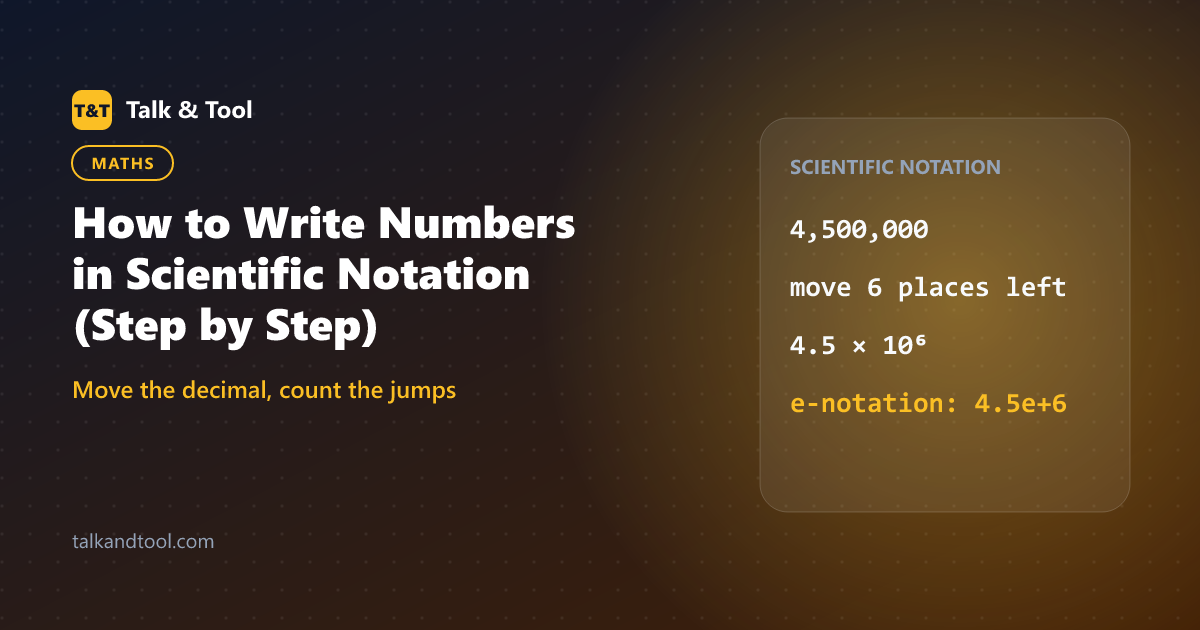
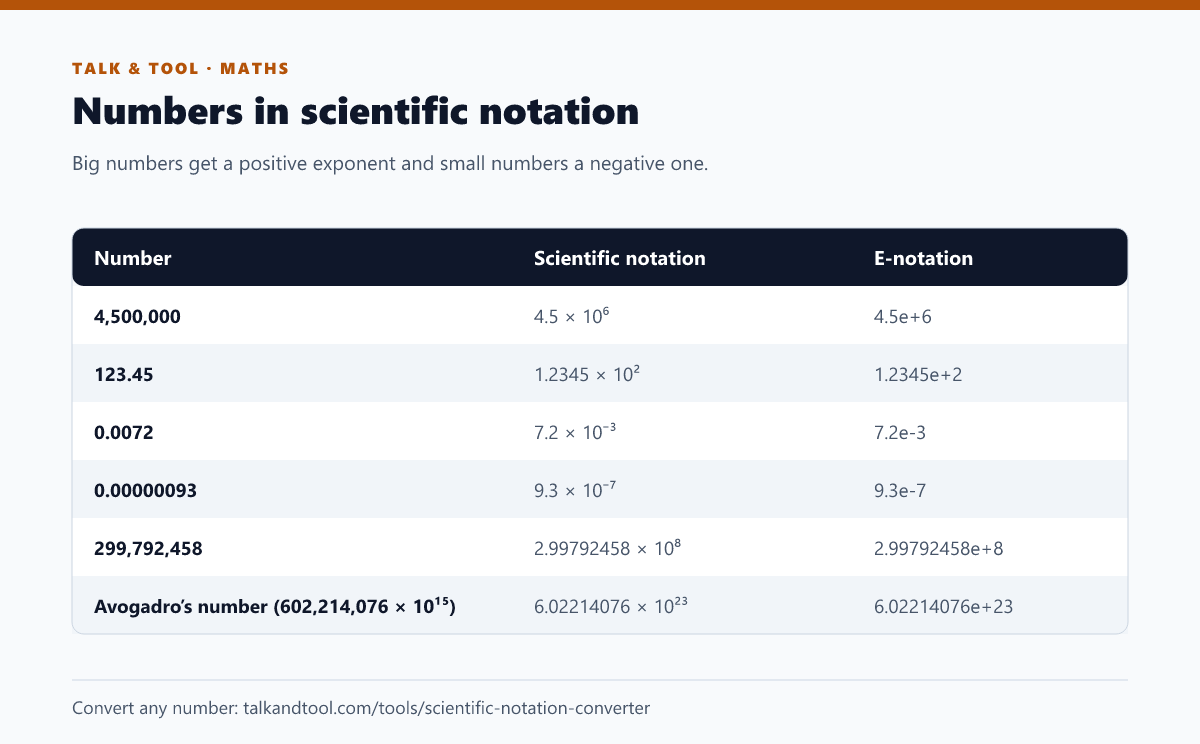
To write a number in scientific notation, move the decimal point until one non-zero digit is in front of it, then multiply by 10 raised to the number of places you moved it. 4,500,000 becomes 4.5 × 10⁶ because the decimal moved six places left. A small number like 0.0072 becomes 7.2 × 10⁻³ because it moved three places right, which gives a negative exponent.
The format
Scientific notation has the form a × 10ⁿ, where:
- a (the coefficient or mantissa) is at least 1 and less than 10.
- n (the exponent) is a whole number, positive or negative.
It exists so that very large and very small values can be written briefly and compared at a glance. The distance to the sun is about 1.5 × 10⁸ km, and the diameter of a red blood cell is around 7 × 10⁻⁶ m. Writing all the zeros of either would invite mistakes.
Step by step: large numbers
- Find the decimal point. In a whole number it is at the end: 4500000 is 4500000.
- Move it left until only one non-zero digit is before it: 4.500000.
- Count the places you moved it: 6.
- Write the coefficient (dropping trailing zeros) times 10 to that power: 4.5 × 10⁶.
Another: 299,792,458 (the speed of light in m/s) has the decimal moved 8 places, giving 2.99792458 × 10⁸, or about 3.0 × 10⁸ rounded to two significant figures.
Step by step: small numbers
- Move the decimal point right until it sits after the first non-zero digit: 0.0072 becomes 7.2.
- Count the moves: 3.
- Make the exponent negative, because you moved right: 7.2 × 10⁻³.
A handy rule: big numbers, positive exponent; small numbers, negative exponent. If a number is between 1 and 10 already, the exponent is zero: 6.4 = 6.4 × 10⁰.
Converting back to standard form
Do the reverse: a positive exponent moves the decimal right, a negative exponent moves it left, and zeros fill empty places. 3.2 × 10⁴ is 32,000. 8.1 × 10⁻⁵ is 0.000081. Check the size: if the exponent is -5 the number should be smaller than 0.0001.
Significant figures
All digits in the coefficient are significant. Writing 4.50 × 10⁶ says the value is known to three significant figures, while 4.5 × 10⁶ says two. That is a main advantage of scientific notation over writing 4,500,000, where it is unclear whether the trailing zeros are measured or placeholders.
Calculating with scientific notation
Multiplying
Multiply the coefficients and add the exponents. (3 × 10⁴) × (2 × 10⁵) = 6 × 10⁹. If the coefficient ends up at 10 or more, adjust: (5 × 10³) × (4 × 10²) = 20 × 10⁵ = 2 × 10⁶.
Dividing
Divide the coefficients and subtract the exponents. (6 × 10⁸) ÷ (3 × 10²) = 2 × 10⁶.
Adding and subtracting
First give both numbers the same exponent, then add the coefficients. 3.2 × 10⁴ + 5 × 10³ = 3.2 × 10⁴ + 0.5 × 10⁴ = 3.7 × 10⁴.
Powers
Raise the coefficient to the power and multiply the exponent by it. (2 × 10³)² = 4 × 10⁶.
Where you will meet it
Science and engineering use it constantly: astronomical distances, atomic sizes, concentrations and electrical quantities. Calculators and spreadsheets display it as "e-notation" when a number is too long for the screen, such as 4.5E+6. We explain that format and how programming languages treat it in e-notation explained.
The scientific notation converter converts in both directions and also gives engineering notation (exponents in multiples of three). For related conversions between number bases, try the number base converter, and for unit prefixes such as kilo and micro, the unit converter. If you are working with percentages and ratios of very small quantities, the percentage calculator and how to simplify a ratio may help too.
Frequently asked questions
How do I write 0.00045 in scientific notation?
4.5 × 10⁻⁴. The decimal moves four places to the right.
Is 12 × 10³ scientific notation?
Not in proper form, because the coefficient is not below 10. Move one place: 1.2 × 10⁴.
What is 10⁰?
1. Any non-zero number to the power of zero is 1.
What does a negative exponent mean?
It means a reciprocal: 10⁻³ is 1 ÷ 10³ = 0.001.