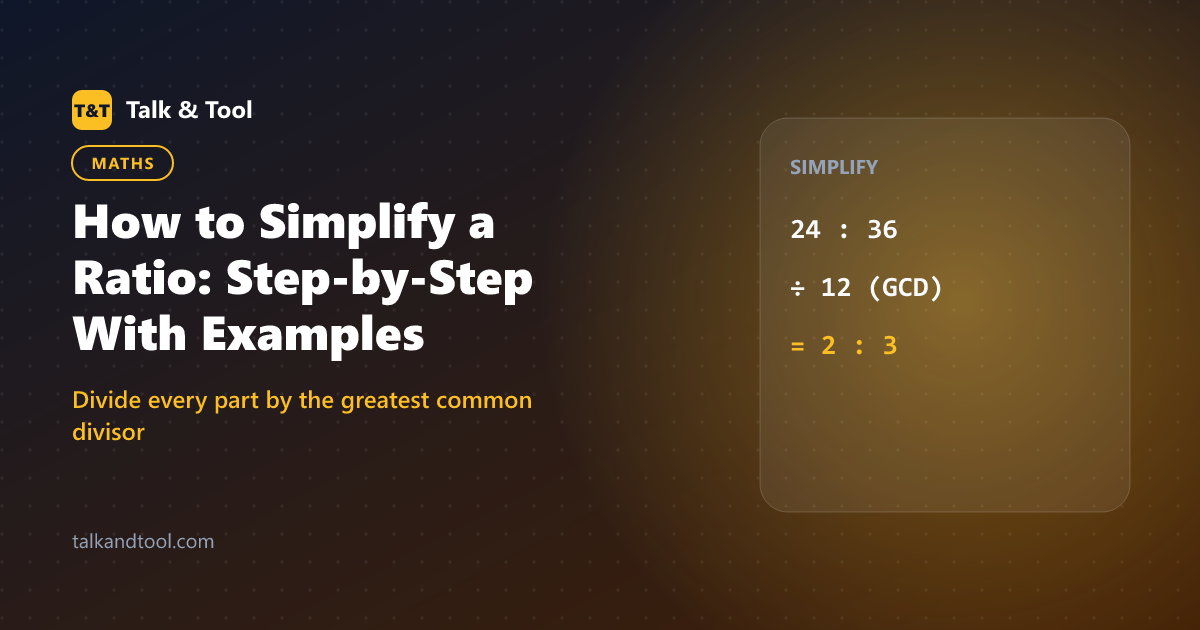
How to Simplify a Ratio: Step-by-Step With Examples
To simplify a ratio, divide every part by their greatest common divisor (GCD), the largest number that divides all of them exactly. For 24 : 36 the GCD is 12, so the ratio simplifies to 2 : 3. If the ratio contains decimals, fractions or different units, convert it to whole numbers in the same unit first. Here are the steps with an example for each case.
The method in brief
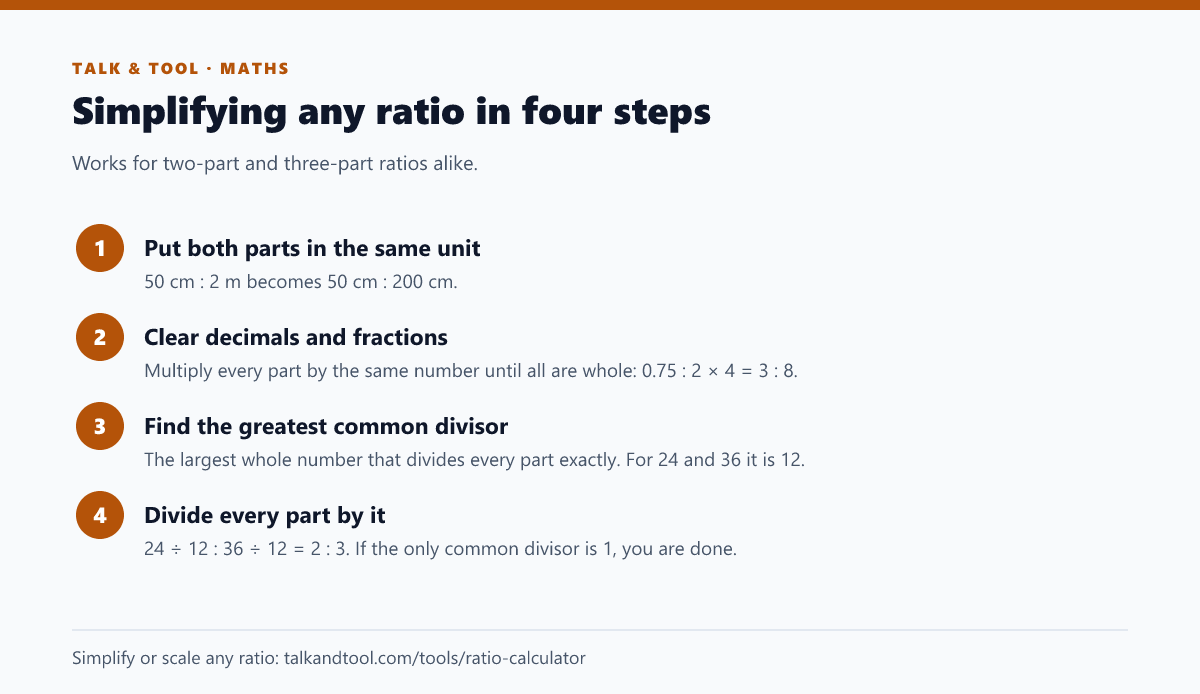
Example 1: whole numbers
Simplify 24 : 36. Factors of 24 are 1, 2, 3, 4, 6, 8, 12 and 24. Factors of 36 are 1, 2, 3, 4, 6, 9, 12, 18 and 36. The largest shared factor is 12. 24 ÷ 12 = 2 and 36 ÷ 12 = 3, giving 2 : 3.
You do not have to find the GCD in one go. Dividing by any common factor repeatedly gets you there: 24 : 36 → (÷2) 12 : 18 → (÷2) 6 : 9 → (÷3) 2 : 3. Stop when no number other than 1 divides both.
Example 2: large numbers, using Euclid's method
Listing factors of large numbers is slow. Euclid's algorithm finds the GCD quickly: divide the larger number by the smaller, keep the remainder, and repeat until the remainder is 0. The last non-zero remainder is the GCD.
Simplify 1071 : 462.
- 1071 ÷ 462 = 2 remainder 147
- 462 ÷ 147 = 3 remainder 21
- 147 ÷ 21 = 7 remainder 0, so the GCD is 21
1071 ÷ 21 = 51 and 462 ÷ 21 = 22, giving 51 : 22.
Example 3: decimals
Simplify 0.75 : 2. Multiply both parts by 100 to get 75 : 200, then divide by the GCD of 25 to get 3 : 8. Multiplying by 4 gets there directly, since 0.75 × 4 = 3.
Multiply by 10 for one decimal place, 100 for two, and so on, using the part with the most decimal places.
Example 4: fractions and mixed numbers
Simplify 1½ : 2¼. Convert to improper fractions: 3/2 : 9/4. Multiply both by the lowest common denominator, 4, to get 6 : 9. Divide by 3 to get 2 : 3.
The fraction calculator helps if the fractions are awkward.
Example 5: different units
Simplify 50 cm : 2 m. Convert to the same unit: 50 cm : 200 cm. Divide by 50 to get 1 : 4. A ratio has no units once simplified, but only if both parts were in the same unit to begin with. Forgetting this gives 50 : 2 = 25 : 1, which is wrong by a factor of 100. The unit converter handles the conversion step.
Example 6: three-part ratios
Simplify 12 : 18 : 30. Find the GCD of all three, which is 6, and divide each part: 2 : 3 : 5. The divisor must go into every part. If one part is not divisible, it is not a common divisor.
Using a simplified ratio
Splitting an amount
To split 1,500 in the ratio 2 : 3, add the parts (5), divide the amount by the total (1,500 ÷ 5 = 300 per part), then multiply: 2 × 300 = 600 and 3 × 300 = 900. The same ratio as percentages is 40% : 60%. The percentage calculator covers the conversion.
Scaling up and finding a missing value
Equivalent ratios let you scale a recipe or solve a proportion. If a mix is 2 : 3 and you have 14 units of the first ingredient, you need 14 × 3 ÷ 2 = 21 of the second. This is the classic "rule of three".
Aspect ratios
1920 × 1080 has a GCD of 120, which gives 16 : 9. To find the height of a 16 : 9 image 1280 pixels wide: 1280 × 9 ÷ 16 = 720. Some screen sizes do not simplify neatly. 1366 × 768 reduces to 683 : 384 and is marketed as "about 16 : 9".
For any of these, the ratio calculator simplifies, scales and solves for a missing value in one place. Ratios and percentages together cover most everyday maths. Our everyday calculator guide walks through the rest.
Frequently asked questions
How do you know a ratio is fully simplified?
When all parts are whole numbers and their only common divisor is 1. For example, 2 : 3 and 51 : 22 are fully simplified, while 6 : 9 is not.
Can a simplified ratio contain decimals?
By convention, no. Multiply through to whole numbers first. The exception is the "1 : n" form, such as 1 : 2.5, which is sometimes used deliberately for comparisons and map scales.
Does the order of a ratio matter?
Yes. 2 : 3 and 3 : 2 are different ratios. Keep the parts in the order the question gives them.