The Fertile Window Explained: The 6 Days Pregnancy Can Happen
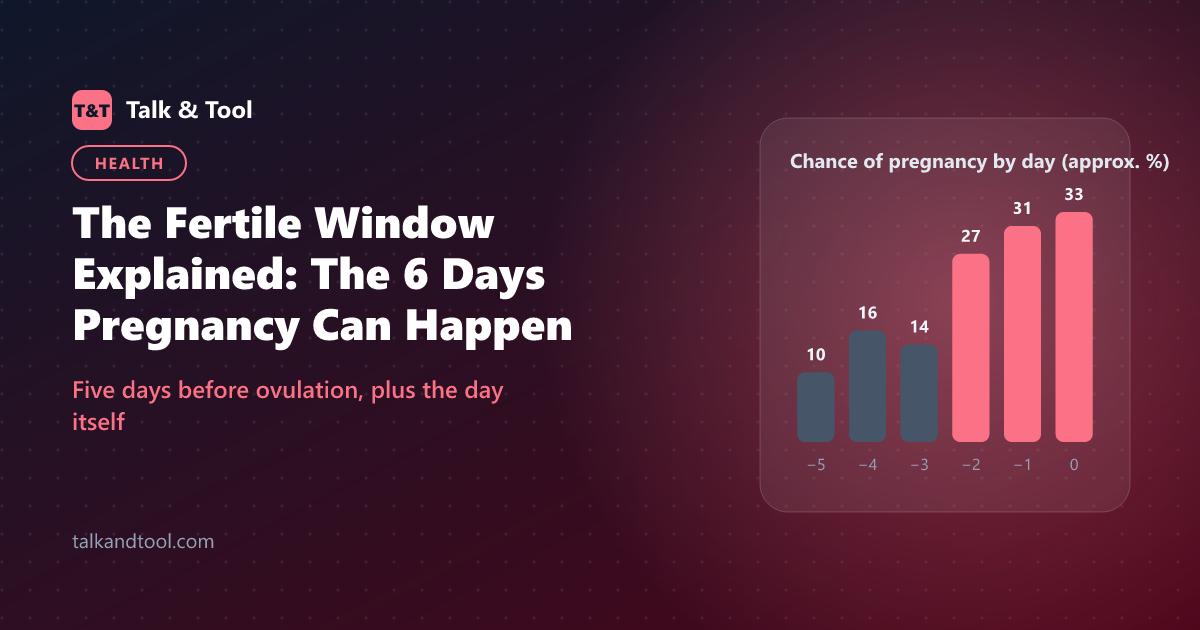
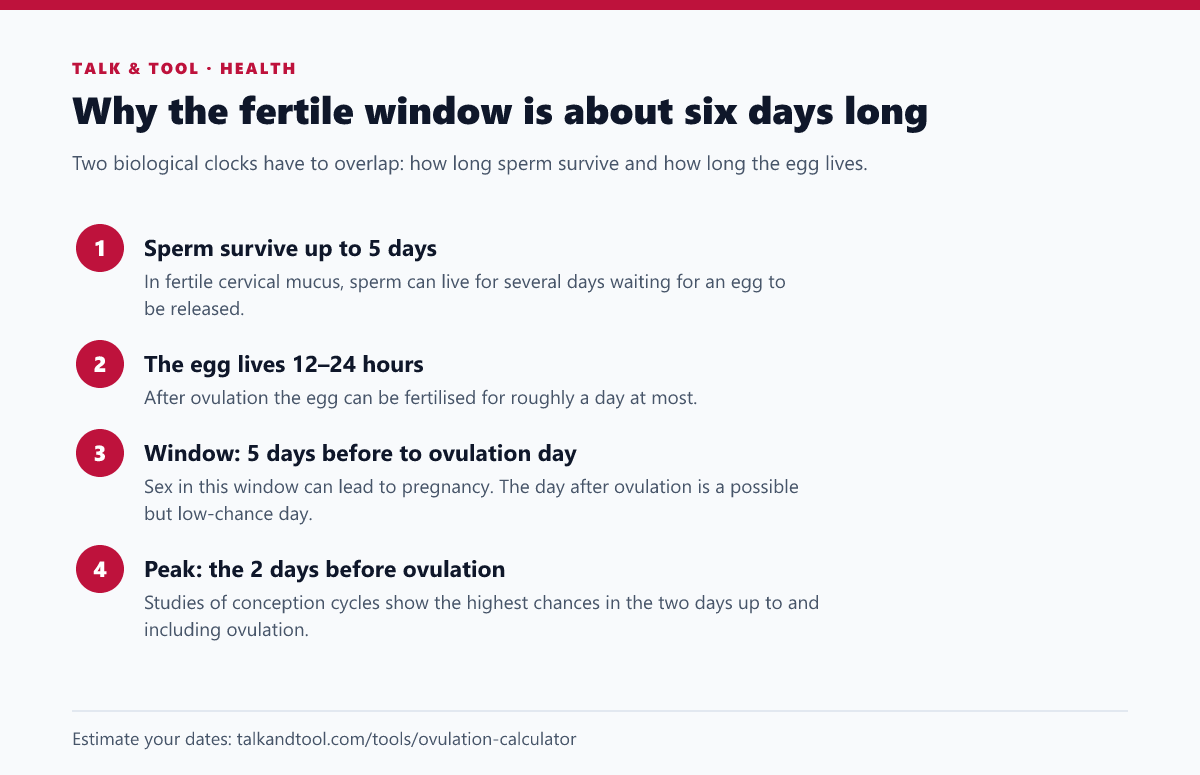
The fertile window is the stretch of about six days each cycle when pregnancy can happen: the five days before ovulation and the day of ovulation itself. It is that long because sperm can survive for up to five days in the reproductive tract, while the egg can be fertilised for only about 12 to 24 hours after it is released. The two days before ovulation, and ovulation day, are the most fertile.
Why the window is longer than the egg's lifespan
A common belief is that you can only conceive on the single day of ovulation. In fact the egg is available briefly, but sperm can wait. Around ovulation, cervical mucus becomes thin, clear and stretchy, which helps sperm survive and travel. Sperm that arrive early can be waiting in the fallopian tubes when the egg is released. So intercourse in the days before ovulation is the most likely route to pregnancy, and sex on the day after has a low chance because the egg is already ageing.
Which days are most fertile?
Research that followed couples trying to conceive, notably a large study published in 1995 using daily hormone data, found that the chance of conception rises across the six days and peaks on the two days before ovulation and on ovulation day itself. The chances were roughly 10% five days before ovulation, growing to about 30% at the peak, and close to zero the day after. The exact percentages differ between studies and people, but the shape is consistent: the peak is right before ovulation, not after it.
That has a practical implication. If you wait for a positive ovulation test or other signs and then start, you may be at the tail end of the window. Having sex every one to two days through the window covers the whole period without needing to pinpoint ovulation exactly.
How to find your fertile window
- Calendar method. Subtract 14 from your cycle length to estimate ovulation, then count five days back. For a 28-day cycle starting 1 March, ovulation is around 15 March and the window runs 10 to 16 March. Use the ovulation calculator or read how to calculate your ovulation date.
- Ovulation test strips. A positive result means a surge in luteinising hormone, and ovulation typically follows within 24–36 hours. Start testing a few days before you expect to ovulate.
- Cervical mucus. Watch for a change to clear, slippery, egg-white texture, which signals high fertility.
- Basal body temperature. A small, sustained rise means ovulation has already happened, so it helps you learn your pattern across cycles but does not predict the current one.
- Cycle tracking apps and wearables. They combine data such as temperature and heart rate to estimate the window. Accuracy varies, and they work best with regular cycles.
If your cycles are irregular
When cycle length varies by a week or more, the calendar method is a rough guide at best. Track signs across several cycles, use ovulation tests over a wider range of days, and speak to a doctor if cycles are consistently shorter than 21 days, longer than 35 days, or absent. Conditions such as PCOS and thyroid disorders can affect ovulation and are treatable.
How long should it take to conceive?
Even when everything is well-timed, the chance of conceiving in any single cycle is about 20–25% for healthy couples in their twenties and early thirties, and it declines gradually with age. About 85% of couples conceive within a year of regular unprotected sex. Clinical guidance usually advises seeking advice after 12 months of trying, or after 6 months if the woman is 35 or older, or sooner if there are known fertility concerns.
What the fertile window is not
- It is not a contraceptive method. Avoiding intercourse in an estimated window fails frequently because ovulation dates move. Talk to a healthcare professional about reliable contraception.
- It is not a guarantee. Fertility depends on both partners and on factors beyond timing.
- It is not a fixed day. Stress, illness, travel and sleep can shift ovulation in one cycle without affecting the others.
Once you conceive
Pregnancy is dated from the first day of the last period, not from conception, which is why a pregnancy is counted as about 40 weeks even though the baby develops over roughly 38. Work out your estimated due date with the pregnancy due date calculator and read how it is done in how to calculate a due date from your last period. To count days between key dates such as ovulation and a test date, the date difference calculator is quick, and the age calculator helps when you want an exact age in weeks.
Frequently asked questions
How many days is the fertile window?
About six days: five before ovulation and ovulation day. The day after ovulation is possible but unlikely.
What are the best days to get pregnant?
The two days before ovulation and ovulation day itself.
Can you get pregnant on your period?
It is unlikely but possible, especially with short cycles, because sperm can survive for up to five days and ovulation can come early.
How long after a positive ovulation test do you ovulate?
Typically within 24 to 36 hours.