How to Calculate Running Pace per Mile and per Kilometre
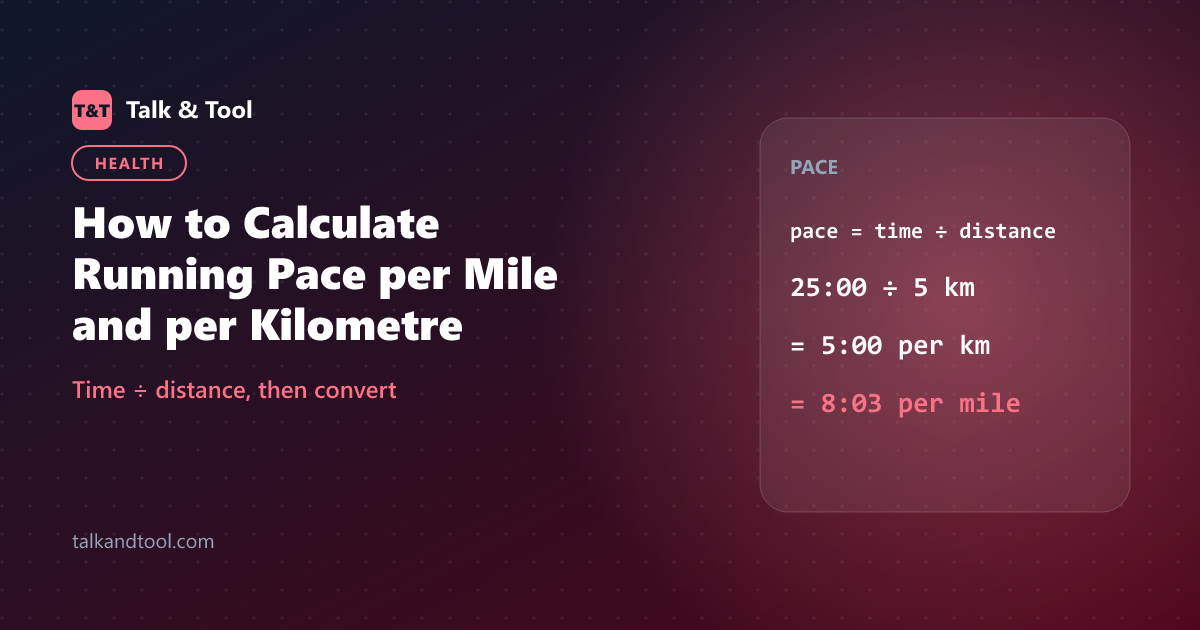
Running pace is how long one kilometre or one mile takes you: divide your total time by the distance. A 5K in 25:00 is 25 ÷ 5 = 5:00 per kilometre. To convert to miles, multiply the pace per kilometre by 1.609, which gives 8:03 per mile. Speed is the inverse: 60 ÷ 5 minutes per km = 12 km/h.
The pace formula
Pace = time ÷ distance
Express the time in a single unit first. If you finished 10 km in 52 minutes 30 seconds, that is 52.5 minutes, and 52.5 ÷ 10 = 5.25 minutes per kilometre. The 0.25 is a fraction of a minute, so convert it to seconds: 0.25 × 60 = 15. Your pace is 5:15 per kilometre.
Always convert the decimal part. Writing "5.15" when you mean 5:15 is the most common slip, and it would be 5 min 9 sec.
Worked examples
- Half marathon in 1:55:00. 115 minutes ÷ 21.0975 km = 5.45 min/km, which is 5:27 per km or 8:46 per mile.
- 5 miles in 42:30. 42.5 ÷ 5 = 8.5 min/mile = 8:30 per mile. Divide by 1.609 for the km pace: 8:30 ÷ 1.609 = 5:17 per km.
- Treadmill at 10 km/h. Pace = 60 ÷ 10 = 6:00 per km. At 8 mph the pace is 60 ÷ 8 = 7:30 per mile.
Converting between per km and per mile
A mile is 1.609344 km, so:
- Pace per mile = pace per km × 1.609
- Pace per km = pace per mile ÷ 1.609
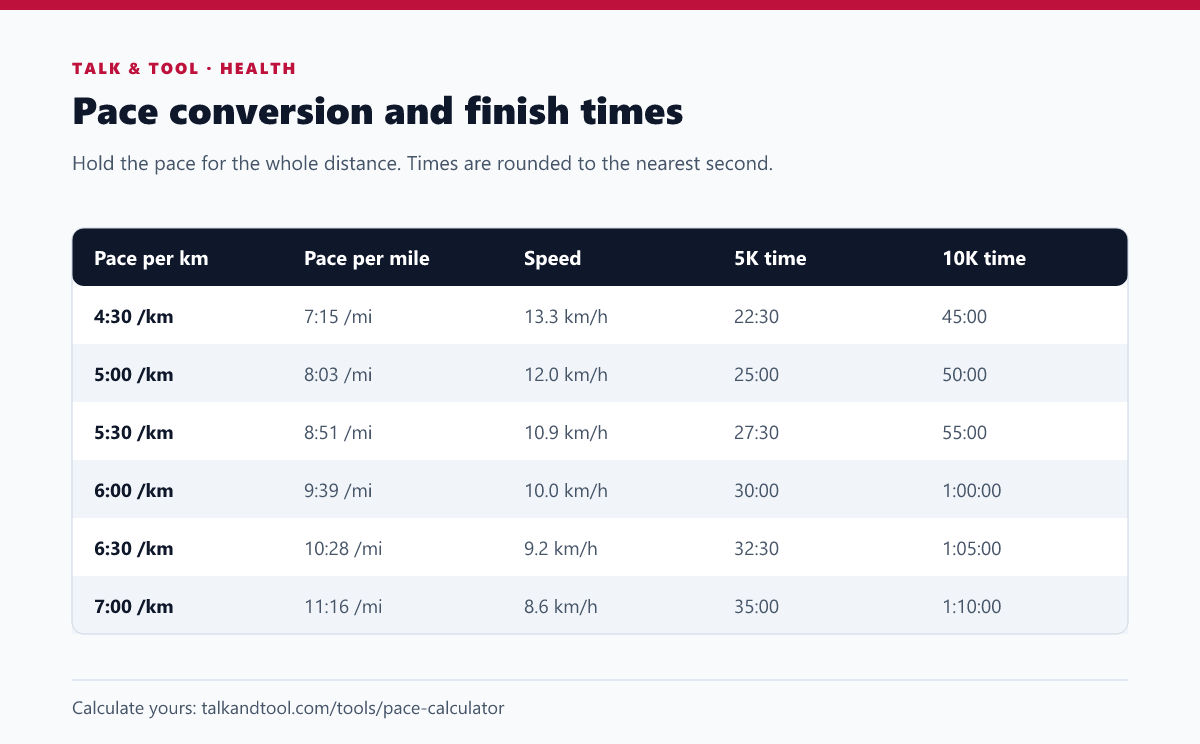
To do it on your fingers, work in seconds. 5:30 per km is 330 seconds. 330 × 1.609 = 531 seconds, which is 8:51 per mile. Going the other way, 9:00 per mile is 540 seconds, and 540 ÷ 1.609 = 335.6 seconds, or 5:36 per km.
Pace to speed and back
Pace and speed are two views of the same thing, and one is the reciprocal of the other:
- Speed (km/h) = 60 ÷ pace (minutes per km as a decimal)
- Pace (min/km) = 60 ÷ speed (km/h)
5:00 per km is 5.0 minutes, so the speed is 12 km/h. 6:30 per km is 6.5 minutes, so the speed is 9.2 km/h. This is useful for treadmills, which show speed, and for training plans, which show pace.
What is a good running pace?
There is no single answer, because pace depends on age, training, terrain and distance. For context, many recreational runners cover a 5K in 28–35 minutes (about 5:40–7:00 per km), and the typical beginner pace is often slower than people expect. A comfortable training run is one where you can speak in short sentences. A good first target is to finish a distance at a steady, even pace; improving pace is a later step.
Using pace in training
- Easy runs. Most of your weekly volume should be at a conversational effort, often 1–2 minutes per mile slower than 5K race pace.
- Tempo runs. Comfortably hard, about the pace you could hold for an hour.
- Intervals. Faster than race pace with recovery, usually over 400 m to 1 mile.
- Long runs. Slow enough to finish the distance feeling you could do more.
Pace targets from a table are a guide. Heat, hills, wind and fatigue can slow you by 10–30 seconds per kilometre without being a problem, so many coaches use effort or heart rate on hard days instead.
Why you cannot just multiply a 5K pace
The projections in a pace table assume you hold the same pace for the full distance. Most runners slow down over longer races, so a 5K pace multiplied up to a marathon is a ceiling, not a prediction. A common rule of thumb is that marathon pace is 15–25 seconds per km slower than 10K pace for trained runners, but it varies a lot. See how pace translates to typical distances in our marathon pace chart.
The pace calculator does these conversions instantly and lists finish times for a mile, 5K, 10K, half marathon and marathon. To match training to your goals, estimate energy needs with the calorie calculator and see how to set the split in how to calculate macros. Hydration needs rise with training, which the water intake calculator estimates, and the unit converter handles miles, kilometres and metres.
Frequently asked questions
What is a 10-minute mile in km pace?
10:00 per mile is 600 seconds, and 600 ÷ 1.609 = 372.8 seconds, so 6:13 per kilometre.
How fast is a 5:00 per km pace?
12 km/h, or 7.5 mph. A 5K at that pace takes 25 minutes.
How do I calculate my finish time from pace?
Multiply pace by distance. At 5:30 per km, a 10K takes 55:00.
Does elevation change pace?
Yes. Hills slow your pace uphill and only partly recover it downhill, so a hilly route is usually slower than a flat one at the same effort.