How to Calculate Percentage Increase and Decrease (With Examples)
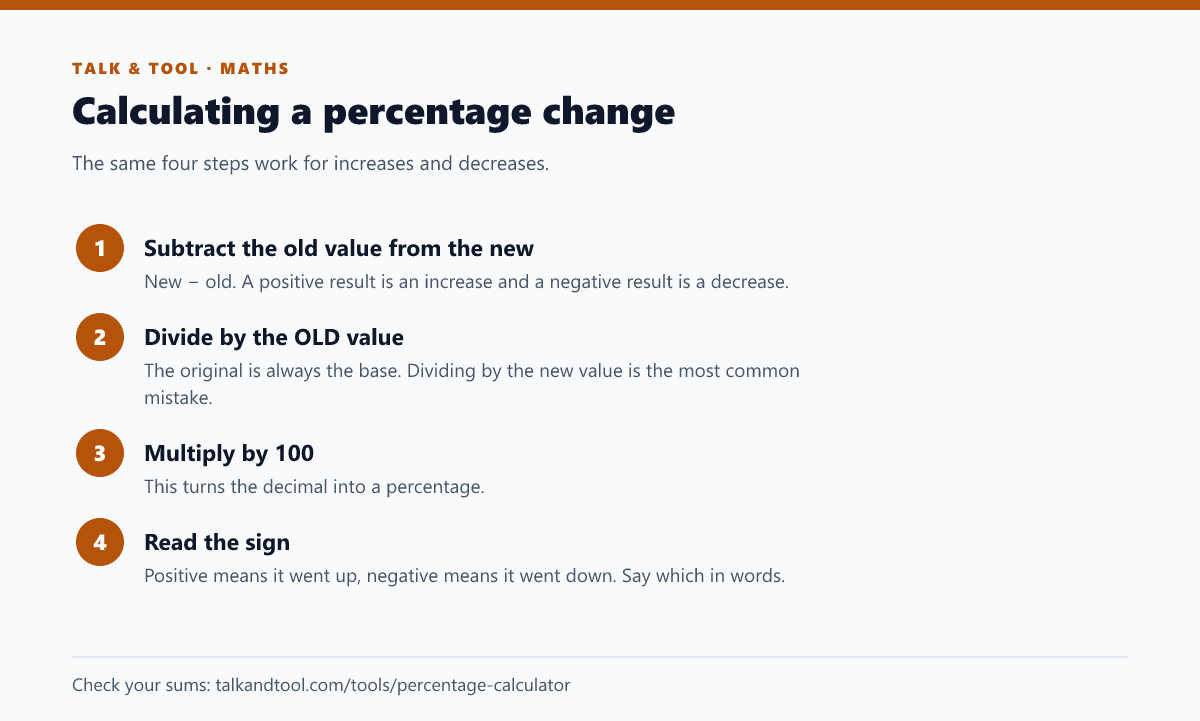
A percentage change compares a new value with an old one and expresses the difference as a share of the old value. The formula is the same whether the number went up or down: subtract the old value from the new, divide by the old value, and multiply by 100. A positive answer is an increase and a negative answer is a decrease. Below are the formula, worked examples and the traps that catch people out.
The formula
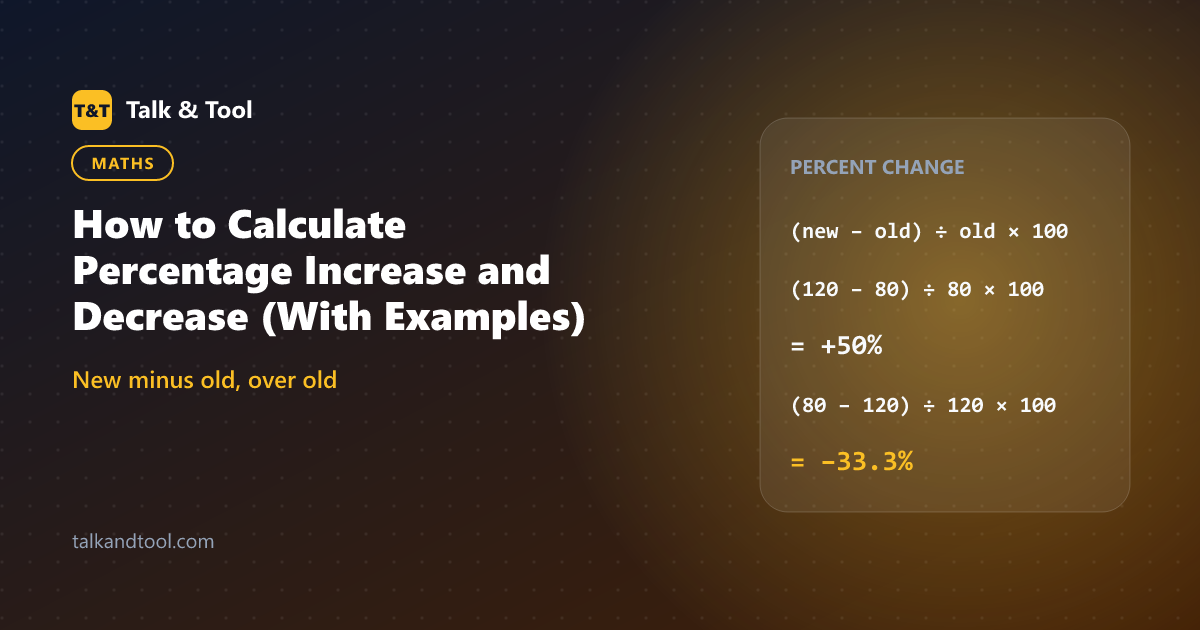
Percentage change = (new − old) ÷ old × 100
Always divide by the old value, the one you are starting from. The old value is the baseline that the change is measured against.
Percentage increase: worked example
A subscription goes from 80 to 120 a month.
- New − old = 120 − 80 = 40
- 40 ÷ 80 = 0.5
- 0.5 × 100 = 50% increase
Percentage decrease: worked example
A price drops from 120 to 80.
- New − old = 80 − 120 = −40
- −40 ÷ 120 = −0.3333
- −0.3333 × 100 = 33.3% decrease
Notice that the same 40-unit gap is a 50% increase going up and a 33.3% decrease going down. The change is the same size in absolute terms, but the base is different each time. That is the single most important thing to understand about percentages.
Finding the new value from a percentage
To apply a percentage change to a number, turn it into a multiplier.
- Increase by p%: multiply by (1 + p ÷ 100). A 15% increase on 200 is 200 × 1.15 = 230.
- Decrease by p%: multiply by (1 − p ÷ 100). A 15% decrease on 200 is 200 × 0.85 = 170.
This is faster than working out the percentage and adding or subtracting it, and it makes a series of changes easy to chain.
Why +50% then −50% does not get you back
Start with 100. Add 50% and you have 150. Take away 50% of that and you have 75, not 100. The second percentage applies to a larger base, so it removes more. To undo a 50% increase you need a 33.3% decrease; to undo a 50% decrease you need a 100% increase. The general rule: to reverse an increase of p%, decrease by p ÷ (100 + p) × 100%.
The same effect hits investments. A fund that falls 40% needs to rise by 66.7% just to break even, which is why avoiding large losses matters more than the arithmetic suggests.
Reverse percentage: finding the original
If you know the final value and the percentage change, divide by the multiplier. A coat costs 68 after a 15% discount. The multiplier is 0.85, so the original price was 68 ÷ 0.85 = 80. A common mistake is to add 15% to 68, which gives 78.2 and the wrong answer, because the 15% was taken from the original, not from the sale price.
Percentage change vs percentage points
These are not the same. If an interest rate rises from 4% to 6%, it has gone up by 2 percentage points, but it has increased by 50% in relative terms (2 ÷ 4). News stories and reports often blur the two, so when you read "rose by 2%" ask which is meant. Use "points" for the difference between two percentages and "percent" for relative change.
Percentage difference is a different thing
When neither value is the "old" one, as when comparing two products, use the percentage difference, which divides by the average of the two: |a − b| ÷ ((a + b) ÷ 2) × 100. For 80 and 120 that is 40 ÷ 100 × 100 = 40%. It gives the same answer in either direction, unlike percentage change.
Where this comes up
- Pricing: discounts, mark-ups and margins. See markup vs margin for how the choice of base changes the percentage.
- Search data: a click-through rate or impressions change between two periods is a percentage change, as covered in what a good CTR is.
- Loans: an interest rate change is often quoted in points; see the loan payment formula.
The percentage calculator handles percentage change, percent of a number and reverse percentages directly.
Frequently asked questions
What if the old value is zero?
The percentage change is undefined, since you cannot divide by zero. Report the absolute change instead, or say the value "went from zero to" the new number.
Can a percentage increase be more than 100%?
Yes. Going from 20 to 70 is a 250% increase. A decrease, however, cannot exceed 100%, since a quantity cannot fall below zero.
How do I calculate a percentage increase in Excel?
If the old value is in A2 and the new value in B2, use =(B2-A2)/A2 and format the cell as a percentage.
How do I calculate a percentage of a number?
Multiply the number by the percentage divided by 100. 35% of 240 is 240 × 0.35 = 84.