Markup vs Margin: The Difference, the Formulas and a Chart
Markup and margin both describe the profit on a sale, but they measure it against different things. Markup is profit as a percentage of cost. Margin is profit as a percentage of the selling price. Because the price is larger than the cost, margin is always the smaller number, and confusing the two is a quick way to under-price a product. Here are the formulas, a conversion chart and the common mistake.
The two formulas
Let profit = price − cost.
- Markup % = profit ÷ cost × 100
- Margin % = profit ÷ price × 100
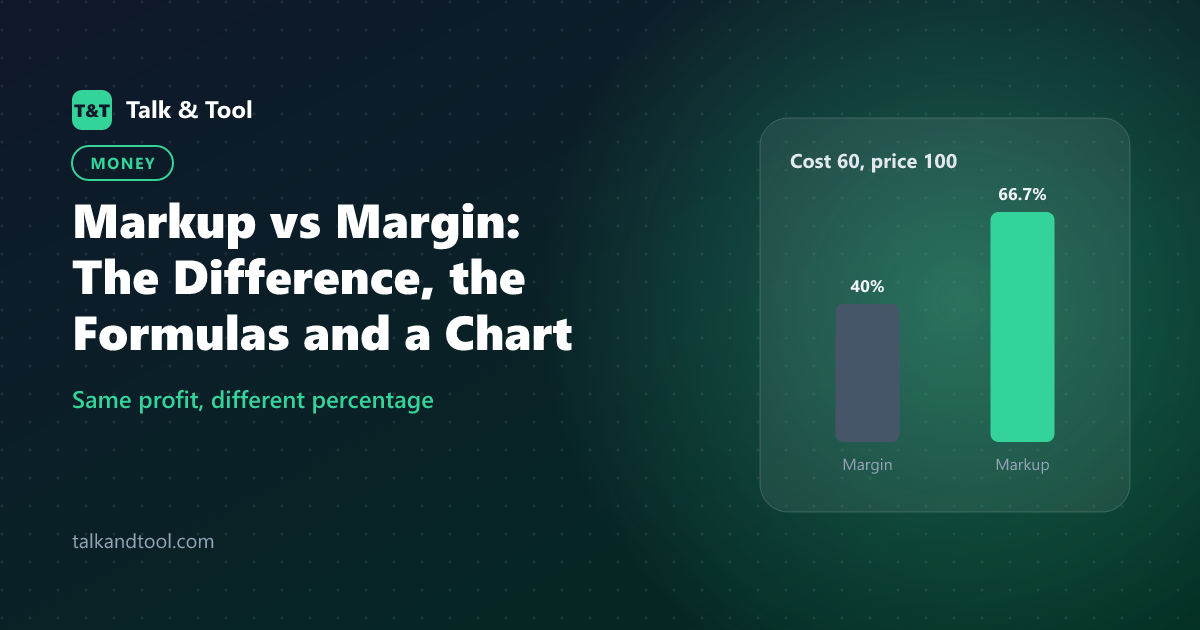
Example: an item costs 60 and sells for 100, so the profit is 40.
- Markup = 40 ÷ 60 = 66.7%
- Margin = 40 ÷ 100 = 40%
Same item, same profit, two different percentages. Neither is wrong; they answer different questions. Markup says "how much did I add on top of what I paid?" Margin says "how much of every sale do I keep?"
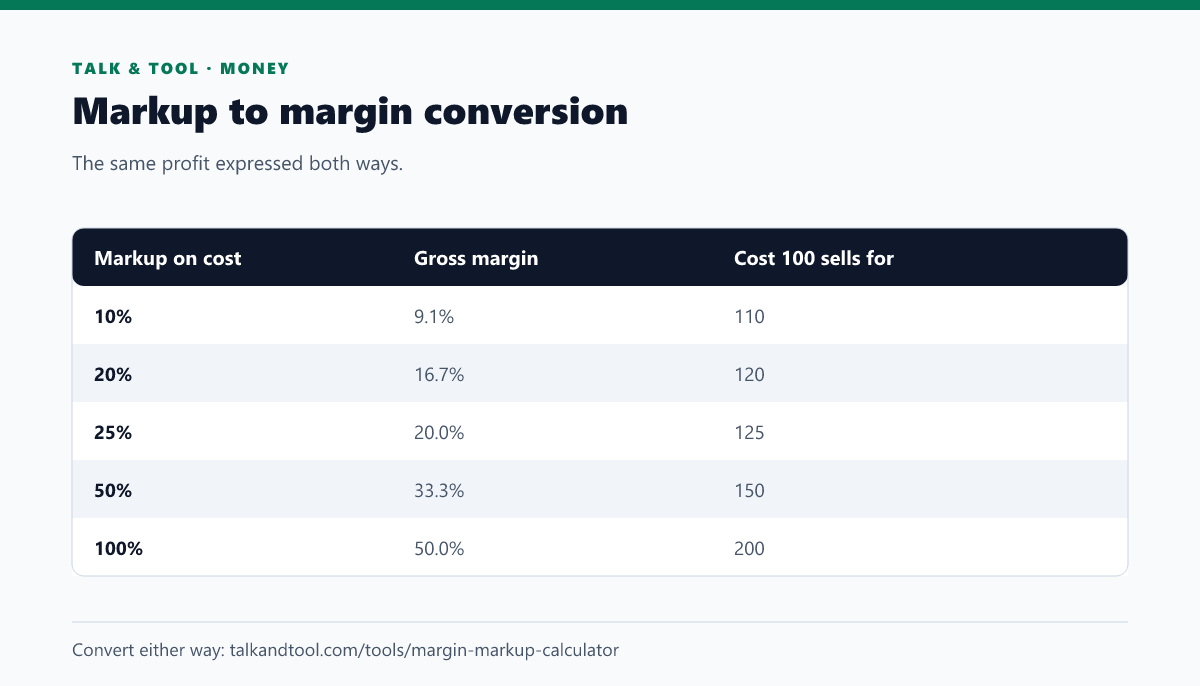
Converting between them
You can convert one to the other with simple formulas, using the percentages as decimals:
- Margin = markup ÷ (1 + markup)
- Markup = margin ÷ (1 − margin)
A 50% markup (0.5) gives a margin of 0.5 ÷ 1.5 = 33.3%. A 40% margin (0.4) gives a markup of 0.4 ÷ 0.6 = 66.7%, matching the example above. The margin and markup calculator does the conversion and also finds the selling price for a target.
Finding the selling price
This is where mistakes cost real money.
- From a target markup: price = cost × (1 + markup). Cost 80 with a 25% markup is 80 × 1.25 = 100.
- From a target margin: price = cost ÷ (1 − margin). Cost 80 with a 25% margin is 80 ÷ 0.75 = 106.67.
The two prices differ by 6.67 on the same item. If you want a 25% margin but apply a 25% markup, you actually earn a 20% margin and give up 5 points of every sale. Over thousands of units, that is the gap between a healthy business and a thin one.
Which one should you use?
Both have uses, as long as you know which one you are reading.
- Markup is convenient for setting prices from known costs. Retailers and contractors often add a standard markup to cost.
- Margin is the standard for reporting and comparing profitability, because it ties directly to revenue: a 30% margin means 30 cents of profit per dollar of sales. Income statements, investors and benchmarks use margin.
The cleanest practice is to price using whichever is easier, then report margin, so numbers from different products and periods can be compared. If you receive a figure and do not know which it is, ask. "We make 30% on everything" has two very different meanings.
Gross margin vs net margin
The margin above is gross margin: price minus the direct cost of the product. It does not include rent, wages, marketing, shipping to the customer, payment fees or tax. Net margin subtracts all of those, so it is lower. When you set a price, a gross margin target must be large enough to cover the overheads and leave a profit. A product with a 30% gross margin and 35% in overheads loses money on every sale.
Quick reference
- Margin < markup, always, for any profit above zero.
- A 100% markup is a 50% margin: you double the cost.
- Margin cannot exceed 100%; markup can.
- Discounts reduce margin faster than they look: see how to calculate a percentage change for the arithmetic of a price cut.
Frequently asked questions
Is markup or margin higher?
Markup is higher for the same profit, because it divides by the smaller number (cost) instead of the larger one (price).
How do I turn a 50% markup into margin?
Divide the markup by one plus the markup: 0.5 ÷ 1.5 = 33.3%.
Can margin be 100%?
Only if the cost is zero. A product that cost nothing to supply would have a 100% margin. Services with low direct cost can approach it.
What is a good margin?
It depends heavily on the industry. Grocery retail often runs in single digits to the low twenties, while software and some services exceed 70%. Compare against your own sector rather than a general figure.