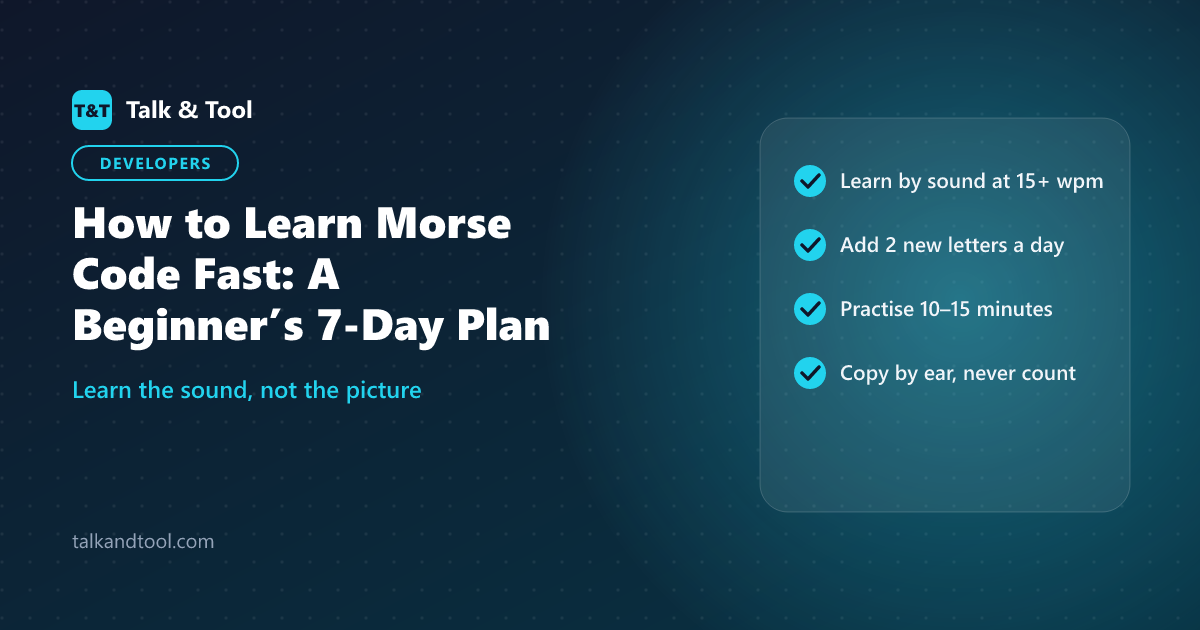
How to Learn Morse Code Fast: A Beginner’s 7-Day Plan
The fastest way to learn Morse code is to learn it as sound, at a speed where you cannot count dots and dashes, and to add letters a couple at a time. In about a week of 10–15 minute sessions you can copy all the letters and digits slowly. Memorising a chart of dots and dashes on paper is the slow route, because it trains you to look something up instead of to recognise a rhythm.
Why the chart is not the best way to learn
Morse is a language of rhythm. The letter L sounds like "di-DAH-di-dit", a distinct pattern, and the chart's ".-.." is only a picture of it. If you learn the picture first and then try to translate it as you listen, you will stall at around five words per minute, because counting takes longer than a character lasts. Experienced operators hear whole letters, then whole words, with no conscious translation.
You still want the Morse code alphabet chart for reference and for checking your work. Use it, but do not rely on it for practice.
The Koch method in brief
The Koch method, developed by the German psychologist Ludwig Koch in the 1930s, is the most commonly recommended approach today. It works like this:
- Use full speed from the start. Each character is sent at about 15–20 words per minute, so it sounds like a pattern rather than a sequence of beeps.
- Stretch the spaces, not the characters. Leave long gaps between letters so you have time to think. This is called Farnsworth timing, and you shorten the gaps as you improve.
- Start with two characters. Copy random groups of those two until you get about 90% correct.
- Add one new character and repeat. Each addition is small, so progress feels steady.
The order matters less than the discipline: it is common to start with K and M, then R, S, U, A, P, T, L, O, W, I, N and on through the alphabet. The plan above follows that sequence.
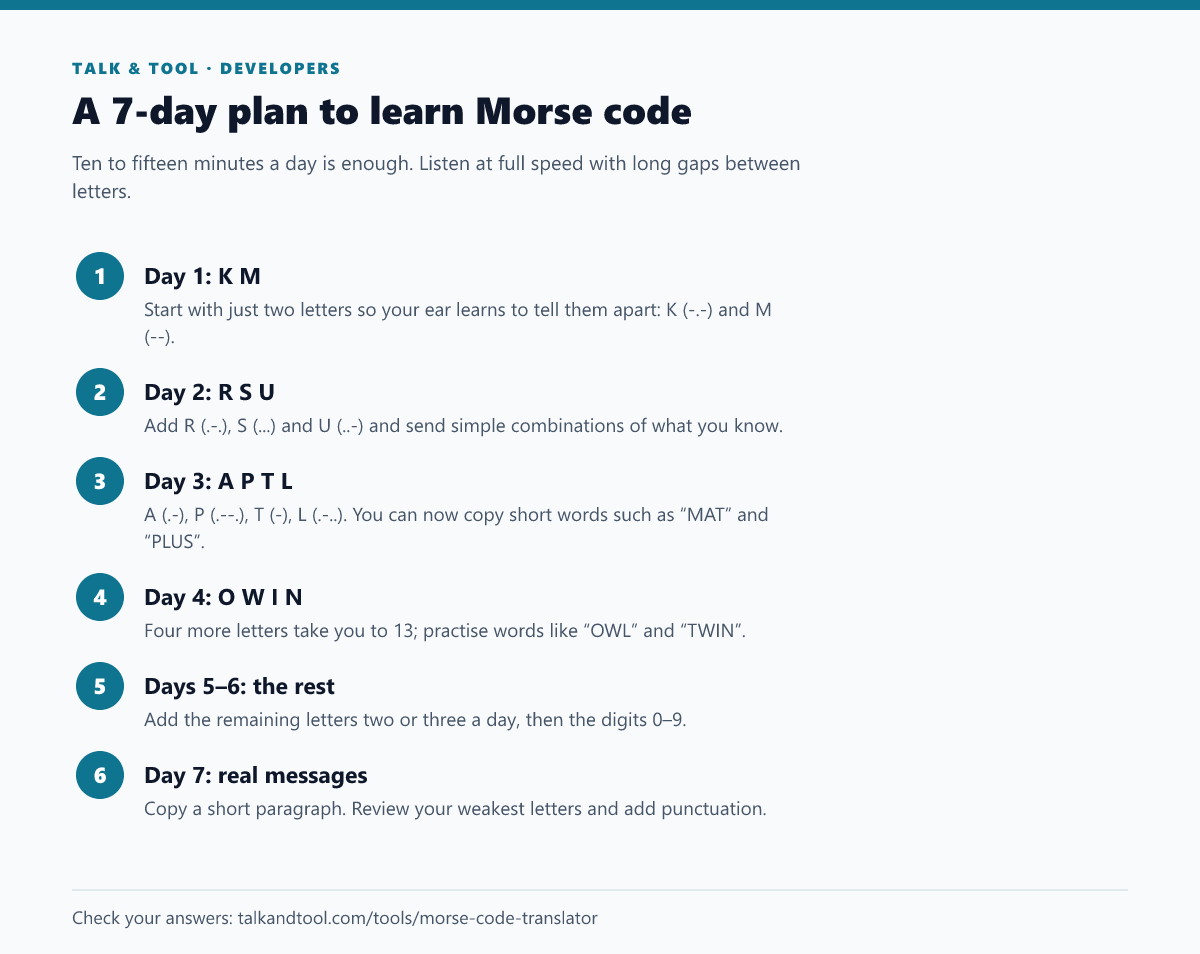
Daily practice that works
- Short sessions. Ten to fifteen minutes once or twice a day beats an hour on Sunday. Sleep consolidates what you practised.
- Write down what you hear. Copy on paper, one character at a time, and do not stop to think about a missed one. Leave a blank and move on, or the next letter will be missed too.
- Check afterwards. Compare with the original text and note which letters you confuse.
- Practise sending too. Tapping out words with a key, a finger on a table or a light flash reinforces the rhythm.
Mnemonics: use with care
Some learners like visual aids such as a tree chart (dot goes left, dash goes right) or word cues where the stressed syllables are the dashes. They can help you get started, but treat them as scaffolding to discard. If you still say a word in your head every time you hear a letter, you will hit a speed ceiling.
Some pairs sound alike and are worth practising specifically: S (...) and H (....), D (-..) and B (-...), and U (..-) and V (...-). Compare them back to back.
Common mistakes
- Practising too slowly. A character sent at 5 words per minute is a collection of beeps. Slow down the gaps instead.
- Counting dots and dashes. If you catch yourself counting, speed up the character rate.
- Adding letters too soon. If your accuracy is under 90%, go back a step.
- Dropping practice for a week. Daily is better than occasional; the skill fades quickly if unused.
- Looking at the answer immediately. Struggling to recall for a few seconds helps memory more than seeing it at once.
Tools for practice
You need a source of Morse audio. The Morse code translator plays any text you type at 15 words per minute, so you can write a word, listen to it, then try to copy it from sound alone before you read the answer. It also decodes your own dots and dashes back to text, which is useful for checking sending practice. Amateur radio clubs and practice apps also provide random groups at adjustable speeds.
If you are curious about how characters can be represented by other codes, compare Morse with the way computers store text in binary, or read ASCII vs UTF-8 for the encoding behind most text today. Both give frequent characters short representations, as Morse does with E and T.
What speed should you aim for?
- 5 wpm: enough to read a short message with effort, usually reached in a few weeks.
- 10–13 wpm: comfortable for slow conversations and the speed of many entry-level amateur radio exams.
- 20 wpm: real conversational speed, typically after a few months of regular practice.
These are typical ranges, not promises. Consistency counts more than talent.
Frequently asked questions
How long does it take to learn Morse code?
With 10–15 minutes of daily practice, most people can copy the full alphabet slowly within one to two weeks. Reaching fluent speeds like 15–20 words per minute usually takes a few months.
Which letters should I learn first?
Under the Koch method, K and M, then R, S, U, A, P, T, L, O, W, I and N. The point is to avoid learning look-alike letters together.
Do I need a key or special equipment?
No. You can learn to receive with audio from your phone or computer, and practise sending by tapping a table or using any button.
Is Morse code worth learning today?
For amateur radio, signalling in emergencies, accessibility devices, and the pleasure of a skill that works with just a light or a tone, yes. It is also a satisfying exercise in pattern learning.