How to Pay Off Credit Card Debt Fast: Avalanche vs Snowball
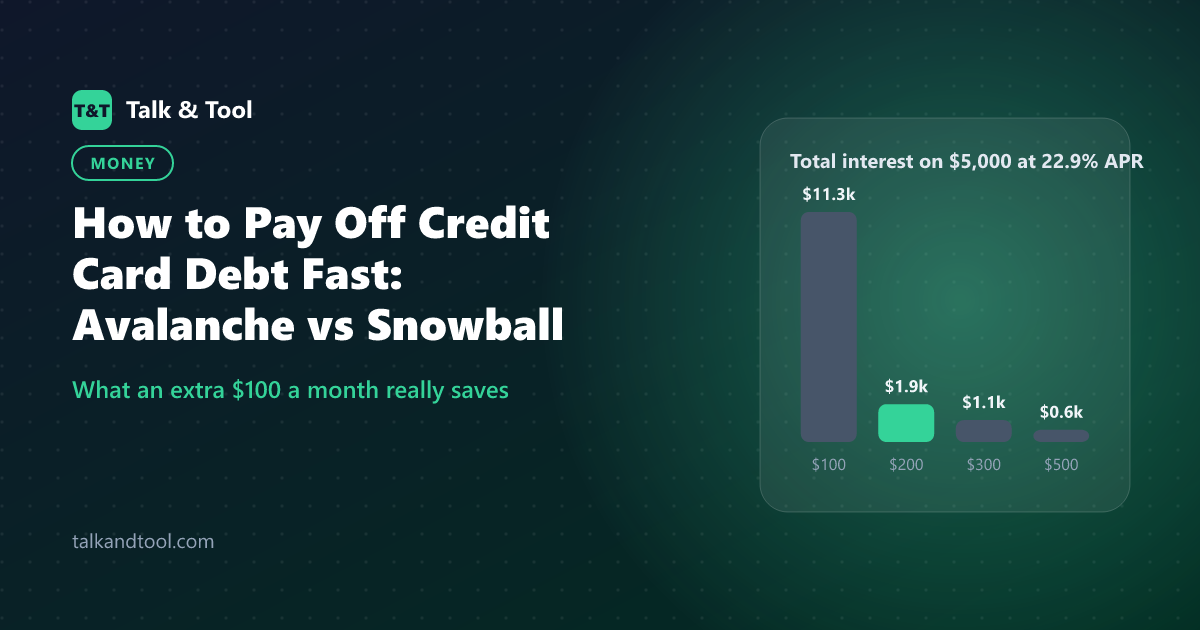
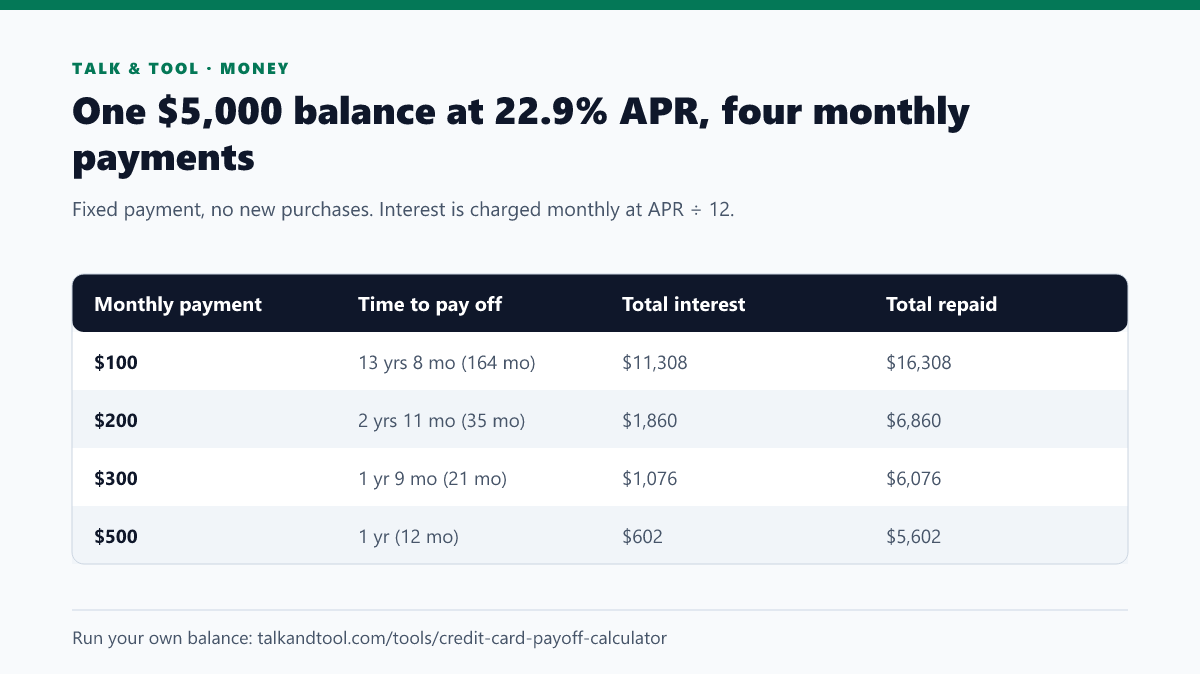
The fastest way to pay off credit card debt is to pay as much above the minimum as you can, every month, and to aim extra payments at the highest-interest balance first. On a $5,000 balance at 22.9% APR, paying $200 a month clears the card in 35 months with about $1,860 of interest, while paying $100 takes nearly 14 years and costs over $11,000 in interest. Below is how that works, and how to choose between the two popular strategies when you have more than one card.
Why small payments barely dent the balance
Card interest is charged monthly on the balance you still owe. At 22.9% APR the monthly rate is about 1.91%, so a $5,000 balance adds roughly $95 of interest in the first month. A $100 payment therefore reduces the balance by only about $5. That is why minimum payments feel endless: most of the money feeds interest, and the balance falls so slowly that interest keeps being charged on nearly the original amount.
Once the payment is clearly larger than the monthly interest, every extra dollar goes straight to principal and reduces all the interest that follows. This compounding effect is why the table's results are so lopsided.
Step 1: find your real numbers
Collect the balance, APR and minimum payment for every card, and the date each statement closes. If you do not know an APR, it is printed on your statement under the interest charge calculation. Add up the minimums: that total is the least you must pay to stay in good standing.
Then decide how much you can pay each month beyond that total. Even a modest, fixed extra amount works well because you keep it constant while individual cards disappear.
Step 2: pick a method
Debt avalanche: highest APR first
Pay the minimum on every card, and put all the extra money on the card with the highest interest rate. When it is cleared, move its whole payment onto the next-highest rate. This approach pays the least total interest, so it is the mathematically optimal order.
Debt snowball: smallest balance first
Pay the minimum on every card and put the extra on the smallest balance, regardless of rate. You clear cards sooner, which gives a visible win and frees a minimum payment to roll into the next card. It usually costs somewhat more than the avalanche, but people who need early momentum often stick with it better, and a plan you finish beats a perfect plan you abandon.
Which one should you choose?
If your cards have similar rates, the difference between the two is small, so pick the snowball for motivation. If one card has a much higher APR (say 29.9% against 17.9%), the avalanche saves meaningful money. Whichever you choose, the rule is the same: keep the total monthly payment constant as balances fall.
Step 3: lower the cost of the debt
- Ask for a lower APR. Issuers sometimes agree, especially after on-time payments. It costs a phone call.
- Consider a 0% balance transfer. A transfer card with a promotional period can stop interest for 12–21 months. Watch for a transfer fee (commonly 3–5%) and divide the transferred balance by the promotional months so it is gone before the rate resets.
- Compare with a personal loan. A fixed-rate loan at a lower APR can cut interest and gives you a set end date. Compare the true cost using the loan calculator, and see how fees affect the real rate in flat rate vs APR.
- Stop adding to the balance. New purchases on a card carrying a balance usually start accruing interest immediately, with no grace period.
Step 4: set a target date and work backwards
A target works better than "as much as I can". To clear $5,000 at 22.9% in 24 months you need about $262 a month; in 36 months about $193. Choose the date you want to be done by, find the payment it needs, and set up an automatic payment for that amount. The credit card payoff calculator gives both answers: the payoff time for a payment you choose, or the payment needed for a deadline, plus a comparison with paying only the minimum.
The underlying formula is the same one that sets loan repayments, which we derive in the loan monthly payment formula. Cards differ only because the minimum shrinks as the balance does, which stretches the payoff.
Where to find the extra money
- Redirect a raise, tax refund or bonus to the balance in full.
- Review recurring subscriptions and cancel what you do not use.
- Sell unused items and put the proceeds on the highest-APR card.
- Pay twice a month instead of once. It lowers the average daily balance a little and keeps you ahead of the due date.
If you are building savings at the same time, keep a small emergency buffer so that an unexpected bill does not go back on the card. See how savings compound in the savings goal calculator and how interest builds up in the compound interest calculator; credit card interest is the same effect working against you.
Frequently asked questions
How long does it take to pay off a $5,000 credit card?
At 22.9% APR it takes 35 months at $200 a month, 21 months at $300 and 12 months at $500. At $100 a month it takes about 14 years.
Is it better to pay off the highest interest card first?
For the lowest total cost, yes. The avalanche method targets the highest APR first. The snowball method costs a little more but can be easier to stick with.
Does paying more than the minimum hurt my credit score?
No. Paying more than the minimum and reducing balances generally helps your credit utilisation, which is the share of your limit that you are using.
What if my payment is less than the monthly interest?
Then the balance never falls. At 22.9% on $5,000, interest is about $95 a month, so any payment at or below that keeps you stuck or growing the debt.