What Is a Good Keyword Density? (And How to Check It)
There is no ideal keyword density for Google. It has never published one, and its ranking systems do not reward hitting a percentage. Most naturally written pages land somewhere around 0.5–2% for their main keyword. The number is still useful as a quick check for two problems: a keyword you forgot to use, and one you have repeated so often it reads as stuffing.
How keyword density is calculated
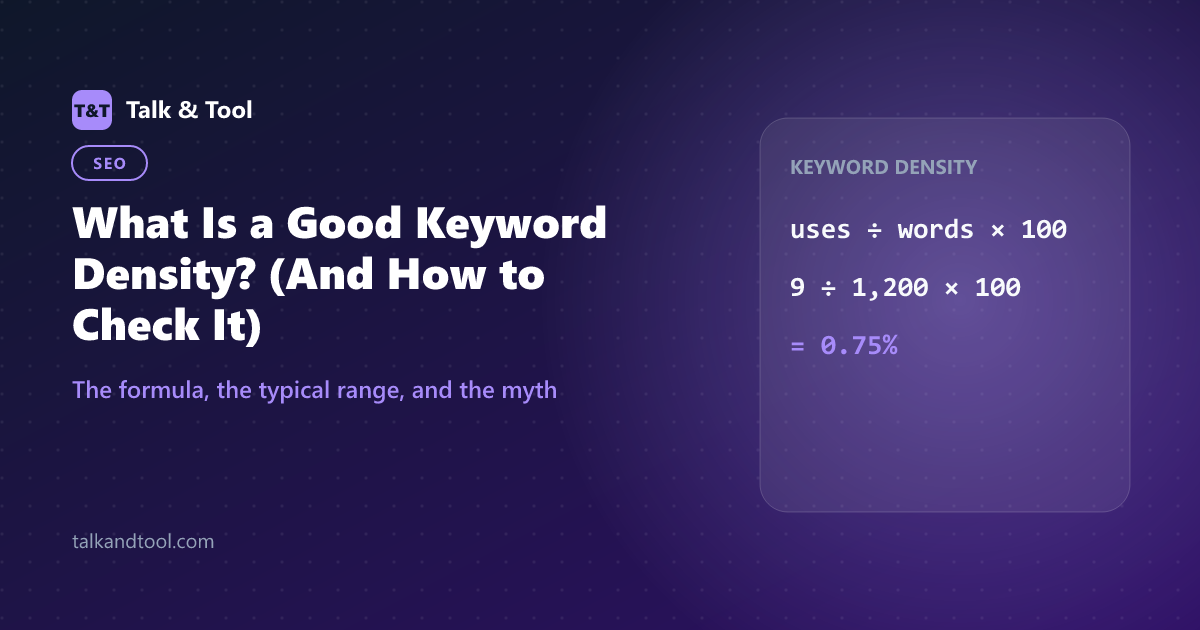
For a single word, keyword density is the number of times the keyword appears divided by the total word count, times 100:
Keyword density = (keyword occurrences ÷ total words) × 100
Example: a 1,200-word article that uses "budget" 9 times has a density of 9 ÷ 1,200 × 100 = 0.75%.
For a phrase, tools differ. Some count each occurrence of "keyword density checker" as one, giving 9 ÷ 1,200 = 0.75%. Others multiply by the number of words in the phrase, since the phrase takes up three words of the text each time: 9 × 3 ÷ 1,200 = 2.25%. Neither is wrong. Just compare numbers from the same tool, or you will think a page doubled its density overnight.
What is a good keyword density?
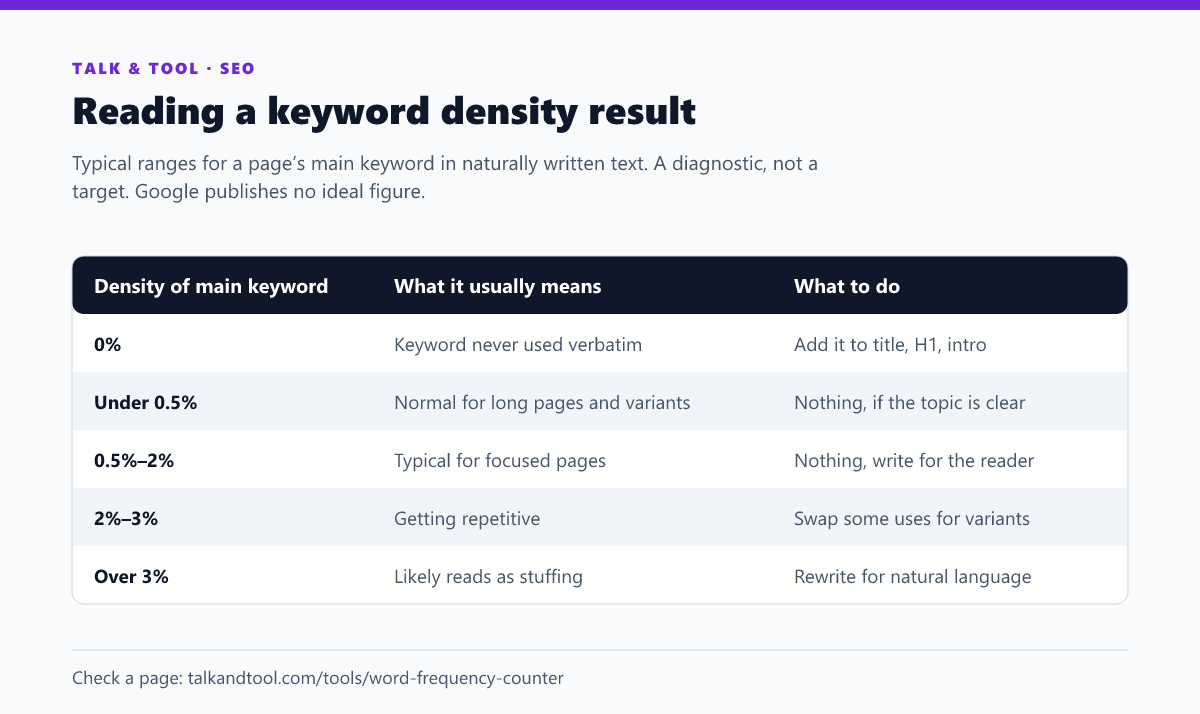
Treat the ranges as smoke alarms, not targets. A page at 0.3% can rank first because it covers the topic thoroughly with varied language. A page at 4% can rank because it is short and the keyword is the product name. What matters is whether the text reads naturally and covers what the searcher needs.
Why density stopped mattering (and what replaced it)
Early search engines matched pages to queries largely by counting words, so repeating a keyword worked. Modern search understands synonyms, related concepts and the meaning of a passage. A page about "how to lower my car insurance" can rank for "reduce auto insurance premium" without using those words at all.
What now matters instead:
- Placement. The keyword or a close variant in the title, the H1, the first paragraph and at least one subheading tells Google and the reader what the page is about. Placement beats frequency.
- Coverage. Pages that rank well mention the related terms and subtopics a knowledgeable writer would naturally include. A mortgage page that never mentions interest rate, term or deposit looks thin whatever its density.
- Intent match. The right format and depth for the query. No density can fix a page that answers the wrong question.
Keyword stuffing: where density still matters
Google's spam policies name keyword stuffing explicitly: filling a page with keywords or numbers in an attempt to manipulate rankings, often out of context. Classic signs:
- The same phrase in almost every sentence, often awkwardly ("Our cheap flights to Paris offer cheap flights to Paris…").
- Lists of cities, keywords or phone numbers with no purpose for the reader.
- Keywords hidden in footers, alt text or in text coloured to match the background.
- Titles that are just comma-separated keyword variations.
If a density check shows your main phrase well above 3%, read the page aloud. If it sounds like a sales robot, rewrite with pronouns, synonyms and more specific detail.
How to check keyword density
- Paste the page text into the word frequency and keyword density checker. Copy only the main content; menus, footers and sidebars skew the count.
- Look at the top single words and phrases. Your main topic should be near the top. If a generic word like "tool" or "best" outranks it, the page may be vaguer than you think.
- Check two- and three-word phrases. These reveal repetitive phrasing that single-word counts miss.
- Confirm placement by eye: title, H1, first 100 words and a subheading.
The word counter is handy alongside it for total length, reading time and character counts, especially when trimming meta descriptions or titles.
What about length?
Density and length are linked: the same number of mentions reads very differently in 300 words than in 3,000. Rather than aiming for a length, match the depth that the top-ranking pages for your query show. We covered that in how long should a blog post be.
A practical writing routine
- Write the draft for the reader without thinking about keywords.
- Put the primary keyword in the title, H1 and opening sentence.
- Run a density check. Add a mention if the main term is missing; vary the wording if it passes about 2–3%.
- Check that related terms a specialist would use are present.
- Read it aloud once. Stuffing is easier to hear than to count.
Frequently asked questions
Is 1% keyword density good?
It is a normal, natural figure for a focused page. It is not a target, though. A page can rank well above or below it.
Does keyword density affect rankings?
Not as a ranking factor in itself. Very low usage can leave a page's topic unclear, and very high usage can be treated as keyword stuffing, which Google's spam policies prohibit.
Do stop words count toward total words?
In most checkers, yes. Stop words like "the", "and" and "of" are included in the total, which is why density figures from different tools rarely match exactly.